
In my postdocs, I am looking essentially for two qualities. The first one can be described as exceptional dedication, resilience, and the ability to work hard. I am looking for someone who would cherish the opportunity to conduct research and be eager to work long hours, not someone who would be watching the clock. Workaholics are lucky people – they love what they are doing and prefer their work to many other activities. The time will come when your health, family duties, disillusionment, or other factors will prevent you from working day and night. But if this time comes when you are 28, you are probably in the wrong field. I have a Japanese print at home that includes a poem. It says: “The difficult takes time, the impossible takes a little longer.” Go for the impossible!
The second quality is even harder to find. The late Lloyd Partridge told me that progress in science comes only when we change our models. Have you always been testing in your mind the models you have been taught? Have you been making some of your teachers uncomfortable by questioning the wisdom they have been feeding you? Great! I really value this ability to critically evaluate what you have learned. I call this independent thinking. This means you have a logical aptitude to distinguish between a model that provides an insight and one that provides only an illusion of understanding. Remember: no changes to the model you are currently using – no progress.
Over the years, I have seen a few books on how to become a scientist. Hans Selye, the author of the stress theory, wrote a good one: “From Dream to Discovery: On Being a Scientist.” I read it in Russian first, and then in English, and it left a deep impression on me. Other books on how to become a scientist, the majority, were not so useful. They explained typical career steps, emphasized the importance of networking, and in general were in line with contemporary corporate propaganda. Instead of reading the latter type of books, you may want to read Ayn Rand’s “The Fountainhead” or Frank Lloyd Wright’s “An Autobiography” – either contains a few lessons for a person who intends to dedicate his or her life to doing something creative and original!
What to expect from working in my lab is illustrated by the painting “Volga Boatmen” by Ilya Repin, a great master of Russian realism. This painting shows how postdocs headed by the PI (in the red lab coat, on the stern of the laboratory) are enjoying their playful adventure and having fun, while each postdoc is exercising the freedom of selecting his own, individual research path. Here is a photo of Repin's painting.
On a more serious note, I have seen too many young (and not so young) enthusiasts who were grossly disappointed to discover that research is 99% hard work, and that an increase in research quality comes at the price of much greater increases both in the effort and time spent. Of course, fun, intellectual enjoyment, and creativity play indispensable roles in research. In fact, the life of a career scientist who does not see poetry in science, who cannot grasp the beauty of the “big picture,” and who is blind to intellectual elegance and deaf to “Eureka!” screams is just pity married to misery. But all these wonderful and truly indispensable things comprise a surprisingly small portion of the everyday life of the laboratory. Without having them, you should not go into research. But without being able to set them aside in a small corner of your life, while filling the rest of it with hard work, you may not achieve much.
I hope the text above has scared away people who should not come to the FeverLab. If you are still with me on this web page, now perhaps I can tell you why you should join my laboratory. I see three good reasons.
First, I can help you learn about thermoregulation. If this is one of your goals, and if you are dedicated to it, I am well positioned to help you achieve this goal. I believe that studying various autonomic and behavioral thermophysiological responses to a variety of stimuli in unanesthetized animals – and this is what FeverLab does – is the most direct way to understand how body temperature is regulated. In my opinion, neuroanatomical, biochemical, molecular biology, or in vitro electrophysiology studies simply cannot give you an equally revealing perspective. It also happens that I have proposed modifications of some important thermoregulatory concepts. Hence, being in my lab will put you in the midst of cutting-edge discussions about thermoregulation, and this is exactly where you want to be if you want to learn about this topic!
Second, the FeverLab may be ideal to further your development from several practical points of view. It is well equipped. For a thermophysiological lab, it conducts research in reasonably diversified areas, which will allow you to express your individuality and take advantage of your strengths. The FeverLab publishes in good journals and has steady productivity. It collaborates with excellent laboratories. It is not the smallest – you will have research comrades and hopefully friends within the lab. It is not the biggest – you will have plenty of one-on-one time with your advisor and a chance to be exposed first-hand to all aspects of scientific life. Even the city of Phoenix, where the lab is located, seems suited for your goal. It is somewhat dull compared to bigger and more colorful metropolises, so the city pushes you gently back into the lab. But Phoenix is still a large cultural center, diverse enough to allow you the full-blooded life expected from a big city. And although our weather is uncomfortably hot for a few months, the rest of the year feels like a wonderful summer!
Third, James M. Krueger, a senior colleague in the field of sleep research, once told me that scientific advisors can be divided into two categories: those who make themselves look bigger by suppressing any growth around them and those who become taller by serving as pedestals for their fellows. I know which type of mentor I try to be. I am also not a bad choice for those fellows who follow the advice of Hans Krebs, the discoverer of the Krebs (or citric acid) cycle and the 1953 Nobel Prize winner in Physiology or Medicine. Krebs wrote: "Select the right mentor, one who can teach you how to be ruthless in criticizing your own work." Not everyone who has come through my lab appreciated these lessons in ruthless criticism! But several did. They have become good scientists. I am happy to watch their successful independent careers and am enjoying their friendship.
Please feel free to contact me – I will be happy to answer any questions you might have. You might also consider visiting FeverLab for a brief tour – or even better – working with us for a few months. Sometimes such short-term project arrangements can be made.
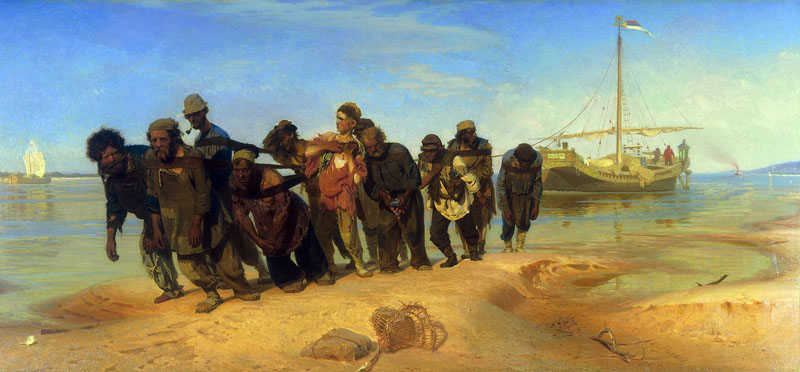
Ilya Efimovich Repin (1844-1930). Volga Boatmen (or Barge Haulers on the Volga), 1870-1873. Oil on canvas. The State Russian Museum, St. Petersburg.
Last updated: December 10, 2010