
 |
 |
 |
 |
 |
 |
|
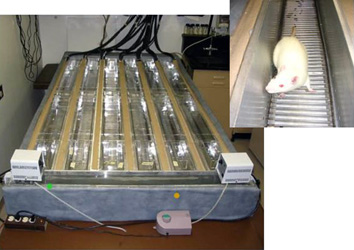
The experimental setups used in Andrej's FeverLab (1999-2019) and briefly described on this page (in the present tense) no longer exist and are listed for historical account only. If you are looking for similar setups, Andrej may be able to refer you to his former postdocs or collaborators, several of whom actively use similar techniques. The FeverLab uses four major physiological setups to study thermoregulation in small rodents: 1. Telemetric thermometry (Telemetry) setup 2. Thermocouple thermometry (Thermocouple) setup 3. Thermocouple thermometry-respirometry (Respirometry) setup 4. Thermogradient setup In all the setups, experiments are conducted at a tightly controlled ambient temperature (or range of ambient temperatures, in the case of the thermogradient setup). Neutral ambient temperatures for common species of small laboratory animals have been determined for each setup (see the descriptions below). Why the same animal has a different neutral ambient temperature in each setup, and how we determine the zone of thermal neutrality, is explained in the following paper:
A basic concept of thermoneutrality is presented in this chapter:
Dramatic examples of how ambient temperature affects the thermal response to different substances can be found in these papers:
In all the setups (except for the thermogradient), drugs are typically administered to animals through preimplanted catheters, from outside the climatic chamber — so that the animals cannot see, hear, or smell the investigator and remain undisturbed during the drug administration procedure. Striking examples of how a non-stressful (vs. stressful) administration of bacterial lipopolysaccharide drastically changes the experimental outcomes can be found in the following papers:
In all our setups, we use multiple animals (typically six to eight) at the same time. Experiments in all our setups require that the animals are habituated to the experimental conditions (see below).
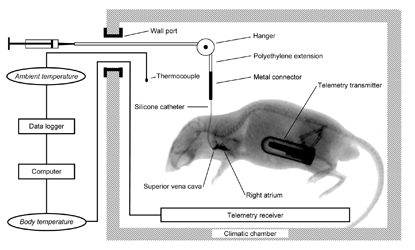
This setup is similar to what many pharmaceutical companies use for testing drugs for temperature effects, except that we conduct all experiments at a tightly controlled ambient temperature (inside a climatic chamber) with the determined relationship to the thermoneutral zone, and we administer drugs in a non-stressful way. This setup is good for identifying strong thermal effects fast. The telemetry setup has been used in several studies in the FeverLab, including these three:
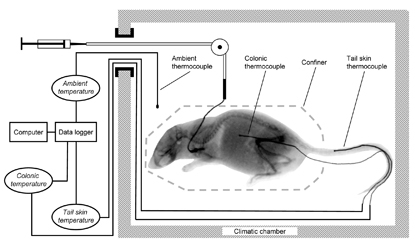
This setup has several advantages over the telemetry setup. First, by measuring tail skin temperature, it allows one to assess tail skin vasoconstriction and vasodilation, i.e., the first autonomic effectors recruited in any cold- and heat-defense responses, respectively. For example, if experiments are conducted at a neutral or slightly supraneutral ambient temperature, an animal injected with a small dose of a pyrogen will readily develop tail skin vasoconstriction and a small fever, which we can reliably detect in this setup. (In the telemetry setup, a small temperature response cannot be confirmed by any effector activity measure.) To assess cutaneous vasodilation/constriction in the tail, we use a tail skin temperature-based measure, which we call the heat loss index. Under a different name, the index was originally proposed by Miklos Szekely in the following abstract:
The heat loss index is extensively discussed in the following paper:
Another advantage of this setup is that the animals stay quietly in restrainers. A restrainer can be regarded as an artificial "rat hole", and both mice and rats generally prefer restrainers over the open space of the cage. The animals do not move inside the restrainers; consequently, their thermal responses are not contaminated with movement artifacts. (In the telemetry setup, even a relatively robust temperature response can be readily masked by movements.) The price to pay for these invaluable advantages is that the animals have to be extensively adapted to this experimental setup. First, we use restrainers to enrich the environment of the animals' home cages, and we allow the animals to enter the restrainers voluntarily (which they do) and to stay there or leave according to their preference. Then, we expose the animals to the investigators. Our technicians and students start gently "handling" the animals, in essence playing with them for a few minutes each day. Finally, we start locking the animals in their restrainers, starting from short periods of time and then increasing this time to a few hours. Rodents are readily adaptable to restraint to an extent that they show no signs of stress when habituated; for references, see this paper:
In the past, several reviewers have criticized our thermocouple thermometry setup as more stressful compared to the telemetry setup. My question is this: if your pet or child were sick, and you needed to know their deep body temperature, would you prefer the surgical implantation of an intraperitoneal probe (see the telemetry setup above) and measuring the temperature of a freely moving subject (so that the measurements are contaminated with movement artifacts) or, would you prefer your child or pet be taught to tolerate the insertion of a rectal probe and to stay quietly in a comfortable position for the time needed for an artifact-free measurement? I know how I would prefer my child’s body temperature be taken. Reviewers have also said that deep body temperature measured in the thermocouple setup is higher than what they see in the telemetry setup, thus suggesting that our animals are stressed. These suggestions, however, are erroneous, as they do not account for two important factors. First, telemetry experiments are usually run at "room temperature", which is typically much lower than the thermoneutral zone for rats and especially for mice. When telemetry experiments (in unrestrained rats) are run at the same ambient temperature as thermocouple experiments in well-adapted restrained rats, the results are the same or nearly the same. For body temperature values and references, see the section "Thermometry in restrained rats: a special consideration" in the following paper:
The other reason why rats in telemetry experiments may have a slightly lower body temperature than rats in thermocouple experiments is that body temperatures in these two types of experiments are measured at different locations: near the front abdominal wall in the peritoneal cavity (telemetry) and inside the colon (thermocouple thermometry). The colonic temperature is one of the highest temperatures in the body and typically exceeds the aortic temperature by a few tenths of a degree; see the same section "Thermometry in restrained rats: a special consideration" (Romanovsky et al. Am J Physiol 275: R323, 1998). This setup has been used extensively in the FeverLab and has allowed us to detect the first febrile phase: the small but consistent rise in body temperature that occurs at the onset of fever in rats and mice; see the following papers:
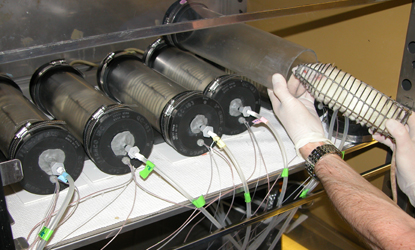
The respirometry setup is essentially the same as the thermocouple setup, except that each rat in its restrainer is placed inside a respirometry chamber, and oxygen consumption is measured. In this setup, it can be tricky to find a good location to measure ambient temperature (which is also used to calculate the heat loss index). If a thermocouple is placed inside a respirometry chamber, the ambient temperature measured is affected by the heat emitted from the rat's body. If a thermocouple is placed outside respirometry chambers (but inside the climatic chamber), the ambient temperature measured is different from the temperature to which the animals inside the respirometry chambers are actually exposed. The typical thermoneutrality values above are given for the latter location (outside the respirometry chambers). This is an example of a study that used a respirometry setup:
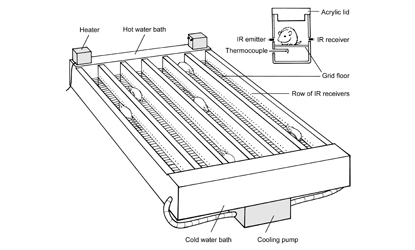
These are examples of studies we ran in the thermogradient setup:
In one of them (Almeida et al. Eur J Neurosci 23: 3359, 2006), we have shown that rats prefer a neutral ambient temperature. Before, it was widely believed that rats prefer a thermally subneutral environment.
|
|